Four ways we stay on the hook
Supply is the easy part. What separates a supplier from a partner is what happens on the day the die wears out, the moisture drifts or the throughput drops.
Installation & commissioning
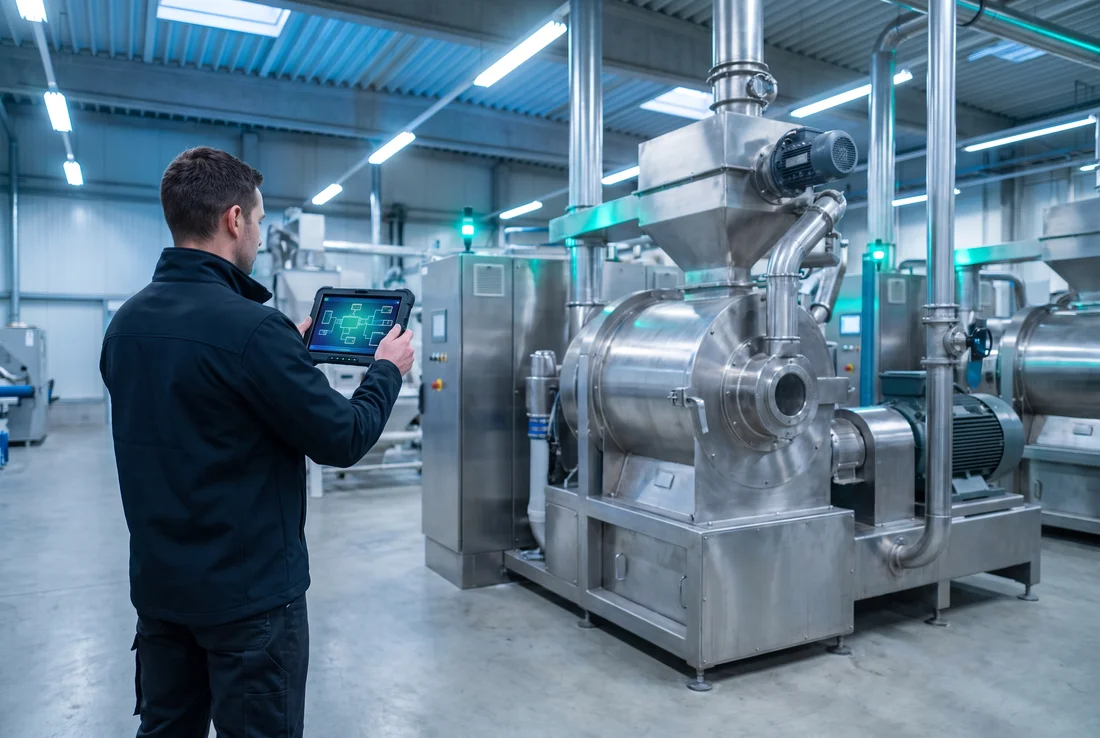
Our supervisors travel to your site, direct the mechanical and electrical installation, run the line with your product and sign off the capacity test against the contract.
Genuine wear parts
Dies, rollers, hammers, screens, screw segments and knives to original tolerances. Recommended stock lists are issued at handover, so the first breakdown is not the first order.
Remote diagnostics
Plants running the SM-IC control system can grant our engineers a secure session: we read trends, alarms and motor loads and tell your team what to change — usually the same day.
Preventive maintenance
Scheduled visits with a written report: die and roller wear, bearing temperatures, screen condition, belt alignment and energy per ton compared with commissioning figures.
Response times, in writing
These are the commitments we sign into every supply contract. If we miss them, you have a written case — not a phone call into the void.
The parts that decide your cost per ton
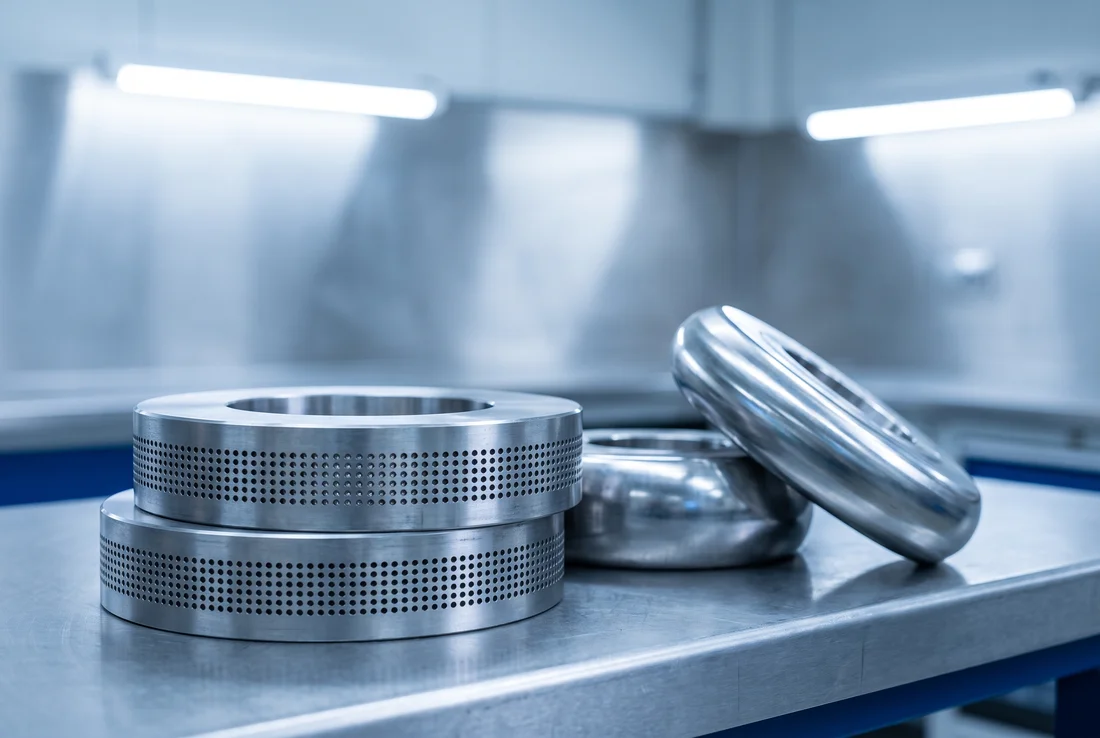
In a feed mill, a handful of consumables set the energy bill and the pellet quality. We machine them to the same tolerances as the originals, because a cheap die is the most expensive part in the plant.
- Ring dies & rollers — alloy and stainless, drilled to your formula and pellet diameter.
- Hammers & screens — hardened hammer sets and perforated screens from Ø1.0 mm upward.
- Screw segments & knives — extruder wear elements for abrasive aqua and pet food recipes.
- Bearings, seals & filter bags — consumables kits per machine, listed by part number at handover.
From order to first tonne
Three questions decide an international purchase: how long it takes, what is included and who installs it. Here are our answers before you ask them.
| Line study, flow diagram and layout | 1–2 weeks |
|---|---|
| Contract, general arrangement and civil drawings | 2–3 weeks |
| Manufacturing and workshop pre-assembly | 8–16 weeks |
| Factory acceptance test (FAT), with your team or by video | 1 week |
| Packing and sea freight | 3–6 weeks |
| Mechanical and electrical installation, supervised | 2–8 weeks |
| Commissioning, performance run and operator training | 1–2 weeks |
Manufacturing time depends on the scope: a single machine ships in weeks, a complete line takes months. We ship EXW, FOB, CIF or DAP — whichever your freight forwarder prefers. Commercial terms are set in the contract, not on a web page.
Included in a line contract
- Process engineering, equipment sizing and plant layout
- All machines, structural steel, chutes and transitions
- Control panels, PLC and SCADA, programmed and tested
- Anchor-bolt and civil load drawings for your builder
- Installation supervision and commissioning on site
- Operator and maintenance training at your plant
- Start-up spare parts kit and wear-part list
- Manuals and HMI in English, Spanish or Chinese
On your side of the fence
- Building, foundations and civil works
- Power supply, steam boiler, compressed air and water
- Local erection labour, cranes and scaffolding
- Import clearance, duties and local permits
What buyers ask us before signing
Do you supply single machines or only complete lines?
Both. Around half of our orders are single machines replacing a bottleneck — usually a hammer mill, a pellet mill or a cooler. We will tell you honestly if the machine you asked for will not lift your output because the constraint is somewhere else in the line.
Can your machines be installed into an existing plant?
Yes. We ask for your current layout, capacities and motor voltages, and we design the machine and its interfaces around them: flange sizes, spout heights, control signals. Retrofits are quoted with the same capacity guarantee as new lines.
What voltage and frequency do you build for?
We build for your site: 380 V / 50 Hz, 400 V / 50 Hz, 440 V / 60 Hz and 480 V / 60 Hz are all standard. Tell us the site conditions with the enquiry and the motors and panels are specified accordingly, with the certification your country requires.
How long does a project take?
A single machine is typically 45–70 days from confirmed order to shipment. A complete pelleting line runs 90–150 days depending on capacity and scope, plus sea freight and installation. We publish the schedule in the contract and report against it every two weeks.
Who trains our operators?
Our commissioning engineers, on your line, with your product. Training covers start-up and shutdown sequences, recipe changes, die changes, cleaning and the alarm list of the SM-IC control system. Manuals are delivered in English, Spanish and Chinese.
Which markets do you export to?
We ship to Asia, the Middle East, Africa and Latin America. Contracts, invoicing and payments run through our Hong Kong company, which keeps documentation and banking straightforward for international buyers; the equipment ships from our manufacturing base in Shanghai.
Need parts, or a line that is underperforming?
Send us the machine, the serial number if you have it, and what you are seeing. A process engineer replies — not a ticket robot.
Contact service